

240GB
max output/run
400 million
reads/run
< 12 hours
fastest TAT
4 Tiers
FCN, FCS, FCL, FCU
Speed matters in genomics — and not just for urgent clinical samples. Faster turnaround means tighter experimental iteration, shorter time-to-answer for surveillance workflows, and more efficient use of lab time across every application. The DNBSEQ-G99 is engineered around this principle. Delivering PE150 sequencing with Q40 base quality in approximately 12 hours, it is one of the fastest benchtop sequencers in its throughput class. That speed comes from coordinated advances in biochemistry, optics, fluidics, and temperature control — not from cutting corners on data quality. Q40 accuracy (fewer than 1 in 10,000 miscalled bases) is maintained across key read lengths using MGI’s StandardMPS 2.0 reagents, giving you high-confidence data on the first pass.
What gives the G99 its breadth is the three-tier flow cell system. The FCS (40M reads) handles small targeted panels and rapid-turnaround jobs. The FCL (80M reads) covers the mid-range — oncology panels, microbial genomes, RNA-seq, methylation, and more — with read lengths from SE50 through PE300 and even SE400 for forensics and long-amplicon work. And the FCU (200M reads) extends into whole-exome sequencing territory, delivering up to 120 Gb per flow cell at PE150 and supporting batches of 8 or more exomes per run. With dual flow cell slots running independently, you can pair any two of these formats in a single run — matching throughput to demand without wasting capacity or waiting for a full batch.
For labs running oncology panels, infectious disease assays, or any workflow where next-day results matter, this means samples loaded in the morning can have FASTQ files ready by the end of the day.
FCS (40M reads), FCL (80M reads), and FCU (200M reads) — covering applications from small targeted panels through to whole-exome sequencing.
SE50 for NIPT and low-pass WGS. SE100 and PE150 for the bulk of standard applications. PE300 for 16S metagenomics and long-amplicon work, delivering up to 240 Gb per run on dual FCU flow cells. And SE400 for forensic DNA applications and extended-read requirements.

Clinical Genomics Manager - ANZ & Country Manager - NZ
Need help matching flow cell format and read length to your application?
Our sequencing specialists can model your sample batching, per-sample costs, and turnaround times — reach out and we’ll respond at the earliest.

All our sequencing platforms can work as standalone systems from sample to result without any network connection, eliminating the risk of data breaches and ensuring complete data security.
Go to Page 9 for detailed specifications.
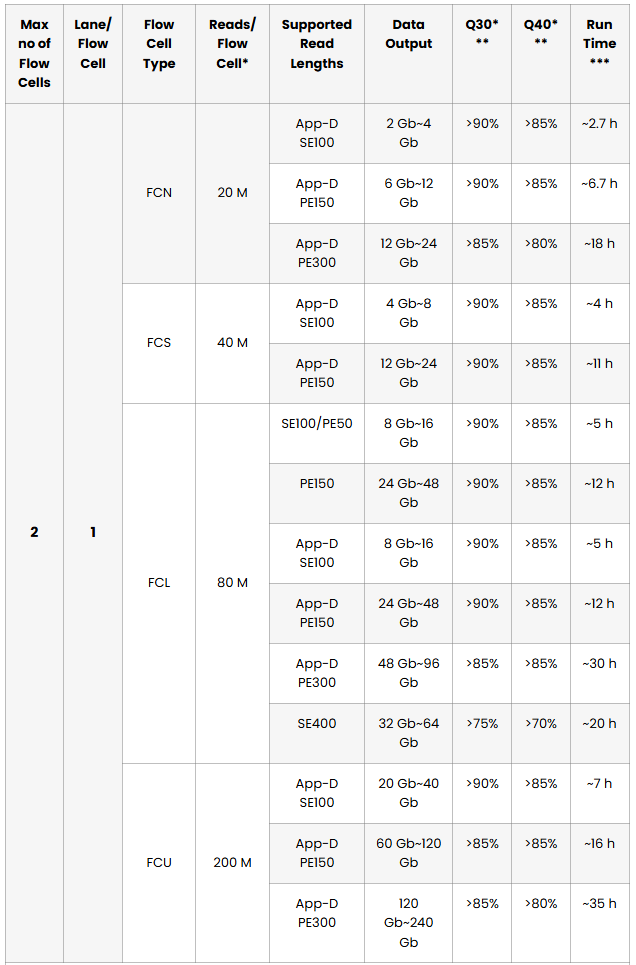
* Effective reads is determined using a standard library. Actual output may vary depending on sample type and library preparation method.
** The percentage of bases above Q30 and run time is the average of an internal standard library over the entire run. The actual performance is affected by factors such as sample type, library quality, and insert fragment length. Only StandardMPS 2.0 (SM 2.0) reagents support the generation of Q40 data.
*** The sequencing time is the statistical duration for single flow cell sequencing and dual flow cell simultaneous sequencing.
★ The instrument is equipped with SE50 and PE100 sequencing modes, and the existing reagent kits support SE50 and PE100 read length sequencing.
Note: APP-D has built-in Illumina’s Truseq, Nextera adapters, and MGI adapter, which supporting mixed testing of Illumina’s Truseq, Nextera adapters, and MGI adapter libraries.
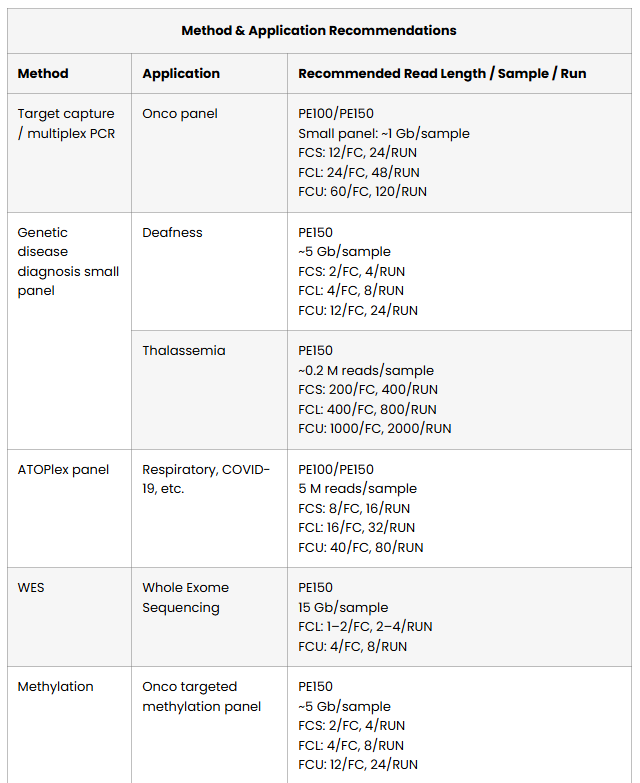

Turnaround time is a clinical deliverable, not a convenience metric. PE150 in 12 hours with Q40 accuracy means panels and exomes can be reported within clinically relevant timeframes. The G99's App-D compatibility with Illumina libraries simplifies validation and transition for labs moving from existing platforms, and the optional bioinformatics module (G99A) enables on-board analysis without external compute infrastructure — reducing IT overhead and data security complexity.
Somatic variant calling at low allele frequencies demands both accuracy and depth. Q40 data quality reduces false positive calls that waste follow-up resources, while the G99's flexible batching — from a handful of samples on the FCS to larger cohorts on the FCU — means you're not over-sequencing small batches or under-powering large ones. Methylation-based cancer detection panels are equally well served, with PE150 support at the depths these assays require.
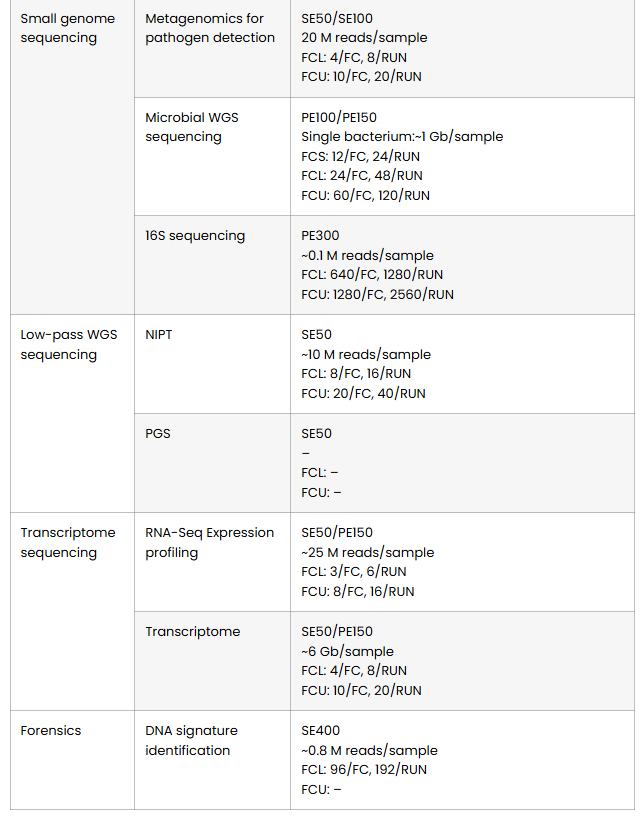
Pathogen identification, resistance profiling, metagenomic screening, and 16S community analysis all run on the G99. SE50 and SE100 modes handle rapid pathogen detection with same-day turnaround. PE300 on the FCL or FCU supports full 16S sequencing for microbiome and environmental monitoring. ATOPlex respiratory and COVID-19 panel workflows are directly supported, and the dual flow cell system lets you run surveillance samples alongside research projects without scheduling conflicts.
If your lab runs RNA-seq one week, targeted panels the next, and occasionally needs an exome or a small genome, the G99 eliminates the need to juggle multiple instruments or batch dissimilar projects together. Three flow cell options, read lengths from SE50 to SE400, and dual independent flow cell slots mean virtually any standard NGS application fits on this single benchtop platform.
We only need these information to serve you better. Decode Science respects your privacy and will never spam you with unrelated content.
The DNBSEQ-G99 is a benchtop genetic sequencer from MGI Tech, built on MGI’s proprietary DNB (DNA Nanoball) sequencing technology. What distinguishes it from other medium-to-low throughput sequencers is its combination of the fastest run speed in its class — 12 hours for a full flow cell PE150 run from loading to FASTQ — with dual independent flow cell operation. It is the only benchtop sequencer in its category that supports dual flow cell loading, allowing two flow cells to run simultaneously or independently with different read lengths. It also achieves Q40 data quality with over 85% of bases at Q40 or above using StandardMPS 2.0 reagents, which is exceptional for its throughput class.
The G99 completes a full flow cell PE150 run from loading to FASTQ in 12 hours, making it the fastest sequencer in the medium-to-low throughput category globally. For comparison, the Illumina MiSeq typically takes 24–56 hours for an equivalent PE150 run. The G99 also supports early data access under Bioanalysis by Sequencing (BBS) mode — users can receive the first batch of summary reports within 2.5 hours of sequencing start at SE40 read length, enabling faster decision-making on time-sensitive samples.
Using StandardMPS 2.0 (SM 2.0) reagents, the G99 consistently delivers Q30 above 90% and Q40 above 85% across all supported flow cell types and read lengths. In validated application data: whole exome sequencing achieved Q30 of 96.64% and Q40 of 91.94%; pathogen detection runs achieved Q30 of 96% and Q40 exceeding 90%; and 16S sequencing runs delivered Q30 of 97% and Q40 exceeding 94%. Note that Q40 data generation requires SM 2.0 reagents specifically.
The G99 supports a broad range of NGS applications including targeted oncology panel sequencing, whole exome sequencing (WES), oncology methylation sequencing, infectious disease sequencing, small whole-genome sequencing, low-depth whole genome sequencing (including NIPT and PGS), 16S metagenomics sequencing, microbial WGS, pathogen detection, RNA-seq, and forensic DNA signature identification. It is especially well-suited to oncology panels, infectious disease, and clinical genomics workflows requiring fast turnaround. Some applications are marked as RUO (Research Use Only) — contact Decode Science for guidance on specific application regulatory status in Australia and New Zealand.
The G99 supports four flow cell types — FCN, FCS, FCL, and FCU — offering escalating throughput:
FCN (20M reads/flow cell): 2–24 Gb depending on read length, run times from 2.7–18 hours
FCS (40M reads/flow cell): 4–24 Gb, run times 4–11 hours
FCL (80M reads/flow cell): 8–96 Gb, run times 5–30 hours
FCU (200M reads/flow cell): 20–240 Gb, run times 7–35 hours
The G99 supports up to 2 flow cells simultaneously, with three loading modes: Single, Dual concurrent, and Dual independent — allowing different read lengths to run on each flow cell at the same time.
Yes. The G99 supports APP-D adapter mode, which has built-in compatibility with Illumina’s TruSeq and Nextera adapters, as well as MGI’s own adapters. This means libraries prepared with standard Illumina library prep kits — including TruSeq, Nextera XT, and Nextera Flex — can be sequenced on the G99 without library conversion when using APP-D flow cells. This significantly lowers the barrier for labs with existing Illumina library prep workflows looking to adopt the G99 platform.
Yes — optionally. The G99 is available in two configurations: the standard G99, which outputs FASTQ files for downstream analysis on a separate compute system; and the G99A, which includes a built-in bioinformatics module. The G99A bioinformatics module begins automated advanced analysis immediately after each flow cell run completes, supports Bioanalysis by Sequencing (BBS) mode for early data retrieval, and is ZLIMS-compatible for workflow management and local data output. The bioinformatics module hardware includes dual Intel Xeon 5220S processors (18C/36T, 2.7GHz), 256 GB RAM, and 32 TB storage.
Yes — validated data demonstrates the DNBSEQ-G99 can detect mutation frequencies as low as 0.5% and 1% with 100% accuracy using targeted oncology panels on FFPE and gDNA standards. In a lung cancer ctDNA study using PE100 dual-barcode sequencing, detection of SNV mutations at 1%, 0.5%, 0.2%, and 0.1% VAF was confirmed with 100% site detection accuracy. For FFPE samples, an end-to-end oncology workflow from sample extraction to analysis report completes in 25.5 hours; for blood samples, the total process time is 21.5 hours.
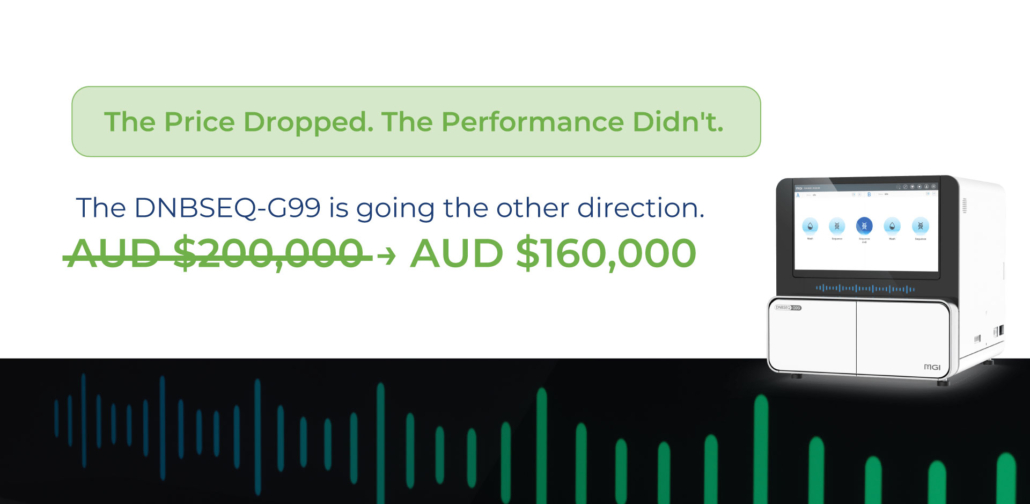
Pricing for the MGI DNBSEQ-G99 in Australia is available through Decode Science, the authorised ANZ distributor. Contact our team directly for a quote — we can advise on instrument configuration (G99 vs G99A with bioinformatics module), flow cell selection for your specific applications, and reagent pricing. Decode Science has also offered trade-in pricing pathways for labs upgrading from existing benchtop sequencers.
For targeted oncology panel sequencing, the G99 offers several advantages over MiSeq: significantly faster run times (12 hours versus 24–56 hours for PE150), higher Q40 base quality scores (>85% versus MiSeq’s lower Q40 rates), dual flow cell flexibility for batching samples more efficiently, and a built-in bioinformatics module option (G99A) for sample-to-report automation. Validated oncology data shows the G99 detects mutation frequencies at 1% VAF from FFPE samples with 100% accuracy and achieves Q30 of 97.88% and Q40 of 94.35% in head-to-head testing. Illumina library compatibility via APP-D adapters also means existing MiSeq libraries can often be run on the G99 without repreparation.
The G99 is a benchtop instrument with the following key specifications: dimensions 607×689×657 mm, weight approximately 140 kg, 21.5-inch LCD touchscreen at 1920×1080 resolution, dual flow cell receptacles, integrated reagent cartridge system (2-in-1 sequencing and cleaning cartridge), rated power 1000 VA (100–240 V, 50/60 Hz), operating temperature 15–30°C, and maximum sound pressure 75 dB(A). The instrument runs Windows 10. The optional G99A bioinformatics module adds dual Intel Xeon 5220S CPUs, 256 GB RAM, 960 GB system disk, 960 GB cache disk, 32 TB storage disk, and Gigabit Ethernet.
Decode Science is the authorised MGI distributor for Australia and New Zealand, providing local instrument support, installation, and service. For instrument service requests, use the Decode Science Service Support system — scan the QR code on your instrument sticker or visit the Service Support page on the Decode Science website. MGI also maintains a global technical support network with a Customer Experience Centre (CEC) in Australia and an international toll-free hotline (+86 4000-688-114) accessible during Beijing business hours. For sales, pricing, and application-specific enquiries, contact Decode Science directly at sales@decodescience.com.au or 1300 581 991.

Simply add your details below and get quick access to the brochure.
Simply add your details below and get quick access to the brochure.
Simply add your details below and get quick access to the brochure.