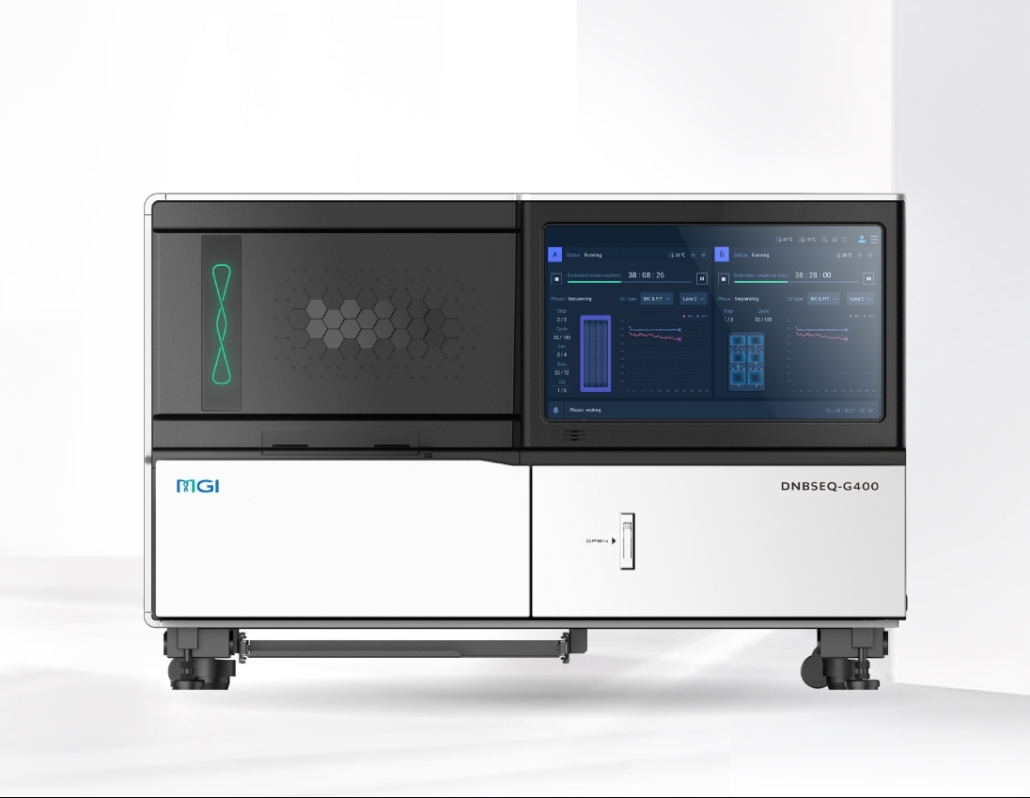
Most genomics labs don’t run one application — they run many. The DNBSEQ-G400 is designed for exactly this reality. With two independent flow cell slots, two flow cell formats (FCS and FCL), and read configurations spanning SE50 through to PE200 and even SE400, the G400 lets you run different applications simultaneously on the same instrument without compromising on turnaround or data quality. Powered by MGI’s StandardMPS 2.0 reagent chemistry, the platform achieves Q40 accuracy across key read lengths — a level of base-calling precision that reduces error rates and strengthens confidence in variant calls, differential expression, and any downstream analysis where per-base accuracy matters.
What makes the G400 particularly practical for mid-scale genomics operations is the balance between throughput and flexibility. The large flow cell (FCL) delivers up to 1,800M reads and 540 Gb per flow cell at PE150, putting whole-genome sequencing, large RNA-seq experiments, and high-depth exome batches comfortably within reach. Meanwhile, the small flow cell (FCS) supports faster, lower-volume runs — ideal for targeted panels, amplicon sequencing, or urgent turnaround samples — without wasting capacity.
Across SE50, SE100, PE100, and PE150 read lengths on the FCL flow cell — meaning fewer than 1 in 10,000 bases called incorrectly.
Pair a high-output FCL run (up to 540 Gb at PE150) with a fast-turnaround FCS run (up to 165 Gb at PE150) on the same instrument, at the same time. No scheduling conflicts, no idle capacity, no need for a second instrument.
Short reads (SE50, SE100) for counting-based applications like RNA-seq and ChIP-seq.
Standard paired-end reads (PE100, PE150) for exomes, genomes, and panels.
And long single-end reads (SE400) for applications requiring extended coverage of contiguous sequence — no hardware reconfiguration required.

Up to 1,080 Gb total output across both flow cells in a single run cycle
At 200 kg and roughly 1 m wide, it's a serious production instrument — but one that fits into a standard lab space without the infrastructure requirements of ultra-high-throughput platforms.

Clinical Genomics Manager - ANZ & Country Manager - NZ
Running multiple sequencing applications and need a single platform that handles them all? Our team can walk you through flow cell configurations, throughput planning, and how the G400 fits alongside your existing setup.
Your users submit everything from targeted panels to whole genomes, and they all want results yesterday. The G400’s dual flow cell design lets you batch high-throughput projects on the FCL while running urgent or low-volume jobs on the FCS — simultaneously. Q40 data quality across key read lengths means fewer reruns and higher first-pass success rates, keeping your queue moving and your users satisfied.
Somatic variant detection demands accuracy. Q40-grade base quality reduces false positive variant calls, particularly at low allele frequencies where sequencing errors and true variants are hardest to distinguish. The G400’s flexible read lengths also let you run tumour-normal WGS, RNA-seq for gene expression, and targeted hotspot panels on a single platform — simplifying your instrument fleet and standardising your data quality.
Drug target validation, biomarker discovery, and companion diagnostic development all require reproducible, high-quality sequencing data across multiple assay types. The G400 supports the breadth of applications these programmes demand — WGS, WES, RNA-seq, methylation, targeted panels — on a single instrument with consistent Q40 performance, reducing the platform-to-platform variability that complicates cross-study comparisons.
Genotyping-by-sequencing, amplicon panels for pathogen surveillance, metagenomic profiling, and small genome assemblies all fit comfortably within the G400’s output range. The SE400 read mode is particularly relevant for applications requiring longer contiguous reads without moving to a long-read platform. For labs processing high sample volumes across diverse project types, the dual flow cell system keeps throughput high while accommodating varied experimental designs.
| Performance by Read Length | ||||
|---|---|---|---|---|
| Read Length | Data Output/Flow Cell | Data Quality Q30* | Data Quality Q40* | Run Time** |
| SE50-FCL | 75 Gb ~ 90 Gb | >90% | >85% | ~14 h |
| SE100-FCL | 150 Gb ~ 180 Gb | >90% | >85% | ~25 h |
| SE400-FCL | 600 Gb ~ 720 Gb | >70% | / | ~109 h |
| PE100-FCL | 300 Gb ~ 360 Gb | >85% | >85% | ~35 h / 38 h*** |
| PE150-FCL | 450 Gb ~ 540 Gb | >85% | >85% | ~50 h / 56 h*** |
| PE200-FCL | 600 Gb ~ 720 Gb | >75% | / | ~107 h |
| SE100-FCS | 55 Gb | >85% | / | ~13 h |
| PE100-FCS | 110 Gb | >85% | / | ~22 h / 26 h*** |
| PE150-FCS | 165 Gb | >85% | / | ~31 h / 37 h*** |
| * The percentage of bases above Q30 and Q40 is the average from internal standard libraries across the full run. Actual results may vary depending on sample type, library quality, and insert fragment length. Q40 is only achievable with StandardMPS 2.0 reagents. | ||||
| ** Run time is calculated based on dual-slide mode and includes sample loading, sequencing, base calling, and data processing. | ||||
| *** 35 h, 50 h, 22 h, and 31 h reflect reduced times with the latest system upgrade. | ||||
We only need these information to serve you better. Decode Science respects your privacy and will never spam you with unrelated content.
Simply add your details below and get quick access to the brochure.