

Pharmacogenomics testing is only as good as the method behind it.
Arrays and short-read NGS can call the variants they were designed to find — but for the genes that matter most clinically, that’s not enough. CYP2D6, the pharmacogene responsible for metabolising approximately 25% of commonly prescribed drugs including opioids, antidepressants, antipsychotics, and tamoxifen, is structurally complex in ways that systematically defeat short-read sequencing:
a 97%-identical pseudogene neighbour causes read misalignment, copy number variants and CYP2D6–CYP2D7 hybrid gene structures cannot be resolved, and haplotype phasing — the step that determines which star allele a patient actually carries — is impossible without reads that span the entire locus.
The Twist Long-Read PGx v2 Panel was built to solve this. A single long read spans the full CYP2D6 gene and its flanking sequence, enabling direct phasing, CNV detection, and hybrid gene resolution in a single assay.
Short reads of 150–300 bp cannot span the CYP2D6 locus or reliably distinguish it from the 97%-identical CYP2D7 pseudogene.
The systematic misalignment errors that result directly affect star-allele calls — and getting the star allele wrong changes the phenotype assignment and the clinical recommendation that follows.
A single long read spans the entire CYP2D6 gene end-to-end: the pseudogene no longer confuses alignment, structural variants sit within one read, and both chromosomes can be phased into an unambiguous diplotype.
Copy number variants, whole-gene duplications and deletions, and CYP2D6–CYP2D7 hybrid gene structures are captured directly.
The v2 Panel covers 30 clinically significant pharmacogenes — including CYP2D6, CYP2C19, CYP2C9, DPYD, TPMT/NUDT15, HLA-A, HLA-B, SLCO1B1, UGT1A1, CYP2B6, G6PD, and VKORC1 — with denser probe tiling, per-exon coverage, and improved probe selection over longer repeat regions compared to v1.
All CPIC Level A gene-drug pairs are covered. The panel design addresses the sporadic CYP2D6 dropout observed in v1 with a new probe tiling strategy delivering uniform coverage across the full gene.
The v2 Panel covers 30 clinically significant pharmacogenes — including CYP2D6, CYP2C19, CYP2C9, DPYD, TPMT/NUDT15, HLA-A, HLA-B, SLCO1B1, UGT1A1, CYP2B6, G6PD, and VKORC1 — with denser probe tiling, per-exon coverage, and improved probe selection over longer repeat regions compared to v1.
All CPIC Level A gene-drug pairs are covered. The panel design addresses the sporadic CYP2D6 dropout observed in v1 with a new probe tiling strategy delivering uniform coverage across the full gene.
The v1 library preparation protocol was identified as a significant source of workflow failure: onerous steps, low library yields, and a high rate of run failures.
The v2 protocol has been independently validated, delivering substantially higher pre-capture yields and improved post-capture library mass for downstream long-read sequencing conversion on both Nanopore and PacBio platforms.
Twist TrueAmp Polymerase is integrated into the workflow, replacing a third-party enzyme with inconsistent supply, while delivering equivalent or better performance across all key metrics including Fold-80, AT% dropout, GC% dropout, and percentage target bases at 30x.
The Twist Long-Read PGx v2 Panel is validated for use on PacBio HiFi (Sequel IIe) and Oxford Nanopore (MinION/GridION, R10.4.1) long-read sequencing platforms. Secondary analysis is supported by platform-native tools — PacBio offers star-allele calling packages; ONT provides EPI2ME with the Chinook CYP2D6 Caller. Third-party clinical reporting pipelines are in development through SeqOne and IntelliSeq. Reference and pro-lab validation is available through Renew Genomics (ONT-certified CRO) for labs developing LDTs.

Clinical Genomics Manager - ANZ & Country Manager - NZ
Approximately 95% of patients carry at least one actionable pharmacogenomic variant. Around 50% of adults are prescribed drugs for which CPIC guidelines exist. Adverse drug reactions contribute to more than 2 million hospitalisations per year globally, at an annual cost exceeding $30 billion. PGx testing exists to prevent this — but only if the method can accurately characterise the variants that drive it.
The problem is not the gene list. The problem is the pharmacogenes themselves. CYP2D6, HLA-A, HLA-B, CYP2A6, CYP2B6, UGT1A1, and G6PD are structurally complex in ways that make short-read sequencing unreliable:
97% sequence identity to the CYP2D7 pseudogene; 160+ star alleles; whole-gene duplications, deletions, and hybrid gene structures that short reads cannot resolve
Extreme polymorphism requiring allele-level typing for abacavir, allopurinol, and carbamazepine hypersensitivity avoidance
Promoter repeat resolution required for irinotecan dosing; the *28 allele depends on repeat number, not a simple SNV
X-linked gene where phasing directly informs enzyme activity
High-fidelity amplification reagent integrated into the PGx v2 workflow; uniform coverage across GC extremes
Bespoke target enrichment for custom gene lists; for labs requiring panel content beyond the standard PGx v2 configuration
End-to-end library prep for target enrichment workflows; validated with Twist panels
| Configuration | Panel Size | Genes | Samples per PacBio Sequel IIe SMRT Cell 8M (~30 Gb) | Samples per ONT MinION/GridION R10.4.1 (~30 Gb) |
|---|---|---|---|---|
| PGx v2 Panel (Lean) — Guideline Focused | 1.8 Mb | 30 | 277 | 277 |
| PGx Core — V1 content + phasing | 6 Mb | 56 | 83 | 83 |
| PGx Expanded — Comprehensive | 7.5 Mb | 93 | 66 | 66 |
Sequencing assumptions: 30x mean target coverage with 50% off-target. End-to-end coverage across all genes in Core and Expanded. High-impact genes only for Lean.
Ordering Information
131401 – Twist Alliance Long-Read PGx v2 Panel, 2 Reactions
131402 – Twist Alliance Long-Read PGx v2 Panel, 12 Reactions
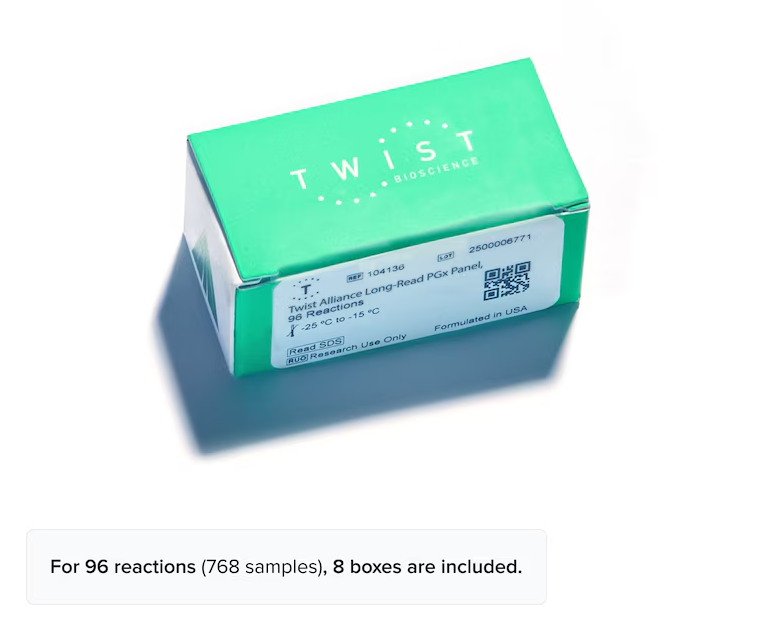
134114 – Twist Alliance Long-Read PGx v2 Panel, 96 Reactions
Short reads of 150–300 bp misalign between CYP2D6 and the 97%-identical CYP2D7 pseudogene. This systematic misalignment means copy number variants, whole-gene deletions, duplications, and CYP2D6–CYP2D7 hybrid gene structures cannot be resolved. Haplotype phasing — which determines which star allele a patient carries — requires reads that span multiple variant positions on the same physical chromosome. Short reads cannot do this reliably, and the star-allele calling algorithms that attempt to compensate show concordance rates ranging from 84–99% depending on the tool. A single long read spanning the full CYP2D6 locus eliminates all of these problems directly.
The same genotype can produce two completely different diplotypes depending on which alleles sit on the same chromosome. For example, a patient with a CYP2D6 duplication could be an ultra-rapid metaboliser (if the functional allele was duplicated) or a normal/intermediate metaboliser (if the non-functional allele was duplicated) — the same copy number, opposite clinical action. Copy number alone is not an answer. Phased, full-gene long-read data is the only way to resolve this unambiguously.
The panel is validated for PacBio HiFi (Sequel IIe, SMRT Cell 8M) and Oxford Nanopore (MinION/GridION, R10.4.1). Throughput is approximately 277 samples per flow cell for the Lean (30-gene) configuration at 30x mean target coverage.
PacBio provides star-allele calling packages for HiFi data. Oxford Nanopore provides EPI2ME with the Chinook CYP2D6 Caller for ONT data. Third-party clinical reporting pipelines are in development through SeqOne and IntelliSeq. For labs developing LDTs, Renew Genomics acts as an ONT-certified CRO reference and pro-lab site.
The v2 Panel addresses four limitations of v1: poor target coverage of key guideline genes (including CYP2D6) resolved through denser probe tiling and improved probe selection; low library yields and high failure rates resolved through a newly validated library preparation protocol; supply chain instability from the third-party polymerase resolved through integration of Twist TrueAmp Polymerase; and updated panel content aligned to current CPIC guidelines including new targets and HLA additions requested by users.
Yes. The Twist Long-Read PGx v2 Panel is for Research Use Only. It is not approved for clinical diagnostic use. Laboratories developing laboratory-developed tests (LDTs) should seek appropriate regulatory guidance for their jurisdiction.
We only need these information to serve you better. Decode Science respects your privacy and will never spam you with unrelated content.

Simply add your details below and get quick access to the brochure.
Simply add your details below and get quick access to the brochure.
Simply add your details below and get quick access to the brochure.